
Exploring Childhood Adversity in Deaf and Hard of Hearing (Deaf/HH) People - Supplementary ACE's
Exploring Childhood Adversity in Deaf and Hard of Hearing (Deaf/HH) People - Supplementary ACE's
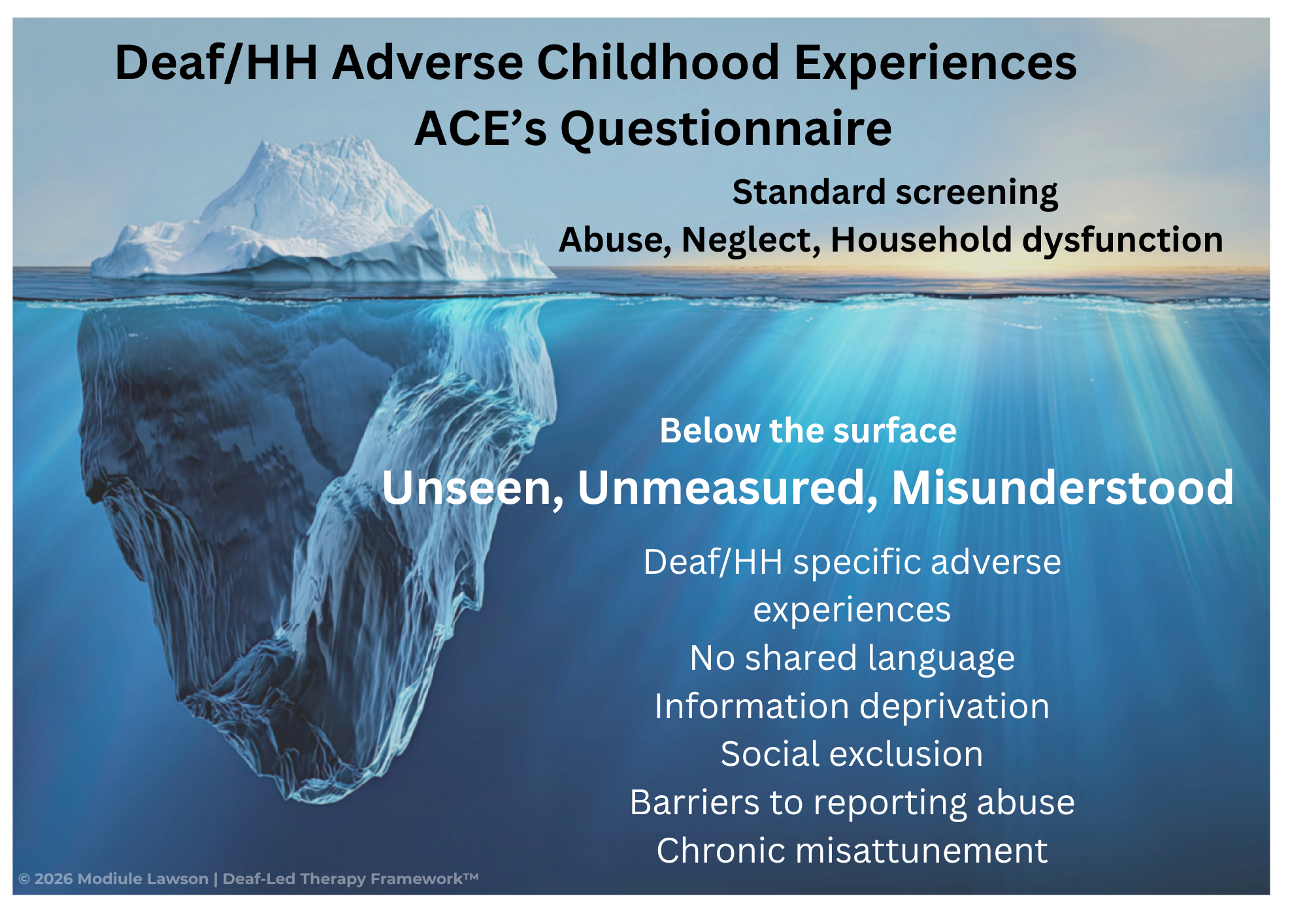
The Adverse Childhood Experiences (ACEs) framework is widely used to explore childhood adversity and its potential lifelong impacts on emotional, psychological, and physical wellbeing. However, traditional ACEs questionnaires may not capture the specific experiences of Deaf and Hard of Hearing individuals, including language deprivation, communication neglect, exclusion from Deaf culture, restrictions on signing, and barriers to accessible healthcare, education, and family communication.
To address this gap, I have developed 13 supplementary questions to the ACEs questionnaire for clinician use, incorporating Deaf specific childhood experiences alongside traditional ACEs. This resource aims to support clinicians in exploring the broader impact of linguistic, cultural, relational, and systemic adversity, recognising that trauma may arise not only from events traditionally identified as adverse childhood experiences, but also from prolonged communication barriers, isolation, and lack of access to an accessible language.
The adapted questionnaire is intended to inform trauma focused clinical discussions and support a more comprehensive understanding of Deaf lived experience. It is a clinician administered discussion resource, not a validated diagnostic instrument, and requires careful interpretation within the individual's developmental, linguistic, cultural, and personal context.
Greater awareness of Deaf specific adversity is essential to developing culturally responsive, language accessible, and trauma informed mental health practice. This resource contributes to ongoing professional discussion and highlights the need for further research into childhood adversity and trauma among Deaf and Hard of Hearing populations.
What Traditional ACEs may miss and rationale for additional questions (13 supplementary questions)
The additional items in this adapted ACEs questionnaire were developed to explore childhood adversities that may not be adequately captured by traditional Adverse Childhood Experiences (ACEs) questions. For some Deaf and Hard of Hearing individuals, adversity may arise not only from conventional categories of childhood trauma, but also from communication neglect, restricted access to language, loss of privacy and autonomy, cultural exclusion, and systemic barriers.
These additions recognise that early access to a fully accessible language, meaningful communication, social connection, and participation in family, educational, and community life can be important to a child's development and psychological wellbeing. Repeated barriers in these areas may contribute to experiences of isolation, powerlessness, shame, reduced autonomy, and disconnection from cultural identity.
The questions are intended to help clinicians explore these experiences within the individual's developmental, linguistic, cultural, and family context. They do not assume that all Deaf people experience these forms of adversity, nor that Deafness itself constitutes trauma. Rather, they direct attention towards potentially adverse experiences arising from inaccessible environments, restricted communication, exclusion, and the responses of others.
The additional items are clinician developed extensions to the traditional ACEs framework. The 13 additional questions, have not been established as a validated Deaf specific measure and should be used as prompts for clinical exploration rather than as a diagnostic instrument or independently validated measure of cumulative childhood adversity.
5 examples below - download Pdf for the full 13 SUPPLEMENTARY questions (total 23 questions)
1. Communication Neglect
“Were your communication needs ignored, for example, you were not taught or supported to learn a fully accessible language (Auslan or other)?”
Clinical rationale
Explores whether a child's communication needs were recognised and adequately supported, including access to a fully accessible language. Limited early language access may affect opportunities for emotional expression, relational connection, learning, and understanding the world. Clinicians should consider the child's actual language access and developmental circumstances rather than assume that hearing status alone indicates language deprivation.
2. Forced Dependence and Loss of Privacy
“Were you forced to rely on a hearing adult or interpreter to communicate private or personal matters, leading to loss of privacy or autonomy?”
Clinical rationale
Explores situations in which dependence on others for communication may have limited a child's privacy, confidentiality, autonomy, or ability to communicate independently. This may be particularly relevant when discussing sensitive matters such as health, relationships, family difficulties, or personal safety. The clinical focus is on the impact of the circumstances, not on assuming that all interpreted communication is harmful.
3. Exclusion and Cultural Isolation
“Were you excluded from Deaf culture or community when you wanted to participate?”
Clinical rationale
Explores experiences of exclusion from Deaf peers, community, language, and cultural participation. For individuals who identify with or seek connection to Deaf culture, restricted opportunities for belonging and shared communication may contribute to isolation, disconnection, or difficulties developing a positive sense of identity. Experiences and cultural affiliations vary, and should be explored without presuming a particular identity.
4. Punishment or Shame for Accessing Language
“Were you punished or shamed for communicating in a way that was accessible to you (e.g., signing)?”
Clinical rationale
Explores experiences in which a child's natural or accessible communication methods were prohibited, discouraged, punished, or stigmatised. Such experiences may contribute to shame, fear of communicating, reduced self-expression, and negative beliefs about language or identity. Clinicians should consider the context, frequency, and impact of these experiences.
5. School and Systemic Adversity
“Did systemic or societal barriers make you feel powerless, invisible, or devalued during childhood?”
Clinical rationale
Explores the potential emotional impact of repeated institutional or societal barriers, including inaccessible education, inadequate communication support, exclusion from decision making, and experiences of discrimination. These experiences may contribute to a sense of powerlessness, invisibility, or diminished personal worth. Clinicians should explore specific events and their impact rather than treat systemic barriers as evidence of trauma in every individual.
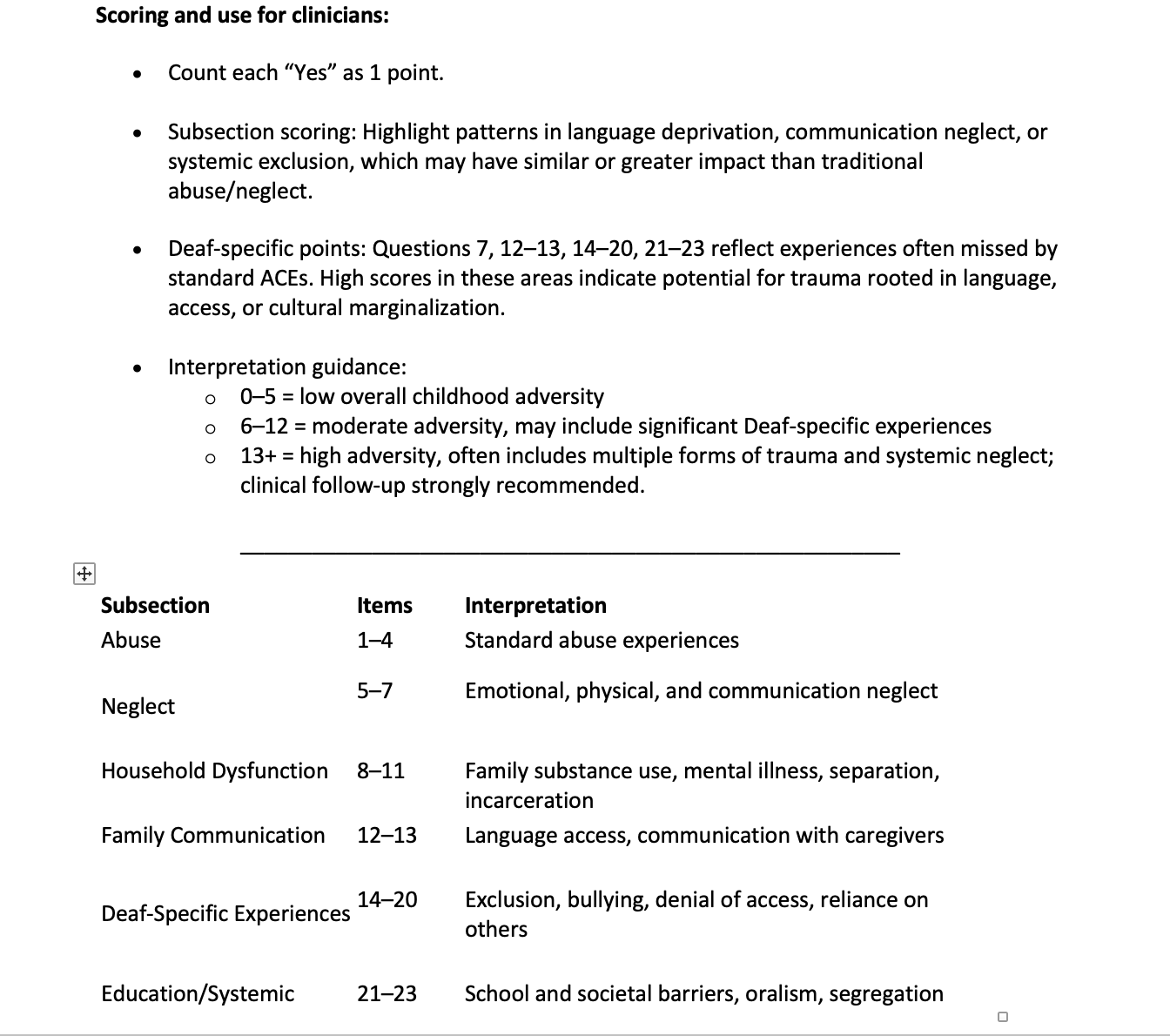
Adaptation clarification
Source:
This tool is an adapted version of the original Adverse Childhood Experiences (ACEs) questionnaire developed by Felitti, Anda, and colleagues (American Journal of Preventive Medicine, 1998) and described by the Centers for Disease Control and Prevention (CDC). Original ACEs items are available here: CDC ACEs Resources.
This is a clinician adapted version of the ACEs questionnaire, specifically designed to include experiences relevant to Deaf and Hard of Hearing clients. It has not been formally validated in research as an official ACEs measure.